
Driving FinTech adoption and growth through distinctiveness
One of the trends FinTech marketers say will matter most in 2026 is “building brand differentiators.” But before losing sleep over how to engineer meaningful differentiation, it’s worth acknowledging an uncomfortable truth: buyers rarely perceive meaningful differences between competing brands.
Decades of evidence from the Ehrenberg-Bass Institute shows that growth tends to come less from superiority and more from mental availability — the likelihood your brand comes to mind when a buying situation arises. When differences are hard to evaluate, people default to what feels familiar and low risk. In other words, you don’t need to be radically different. You do need to be easy to notice and remember.
Brand familiarity is one of the strongest predictors of consideration and choice. Byron Sharp’s summary is disarmingly simple: brands grow by increasing their physical and mental availability. Research from Ipsos, System1 and the IPA suggests that distinctive creative assets such as characters, sonic branding, visual worlds, and humour all strengthen memory encoding and improve long-term effectiveness.
Yet much FinTech marketing still behaves as if customers are calmly comparing spreadsheets of product features. It assumes the rational argument will win. The trouble is, rational arguments are terrible at getting attention. Technology companies are understandably shaped by engineering logic. That mindset is essential when building software. But the creativity required to build products is different from the creativity required to grow brands.
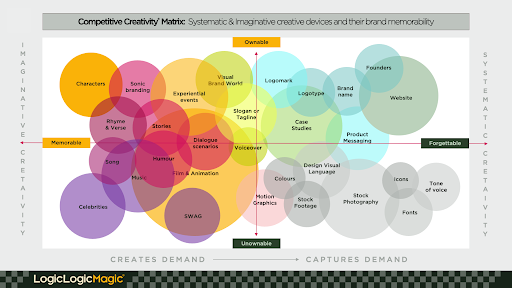
At LogicLogicMagic we describe two modes of creativity. Systematic creativity is logical and reductive. It creates UX journeys, product messaging and design systems that remove friction. Imaginative creativity is emotional and narrative-driven. It creates the stories, characters and distinctive brand worlds that people actually remember. Both matter. But they do different jobs.
Systematic creativity makes products easy to use. Imaginative creativity makes brands easy to recall. The problem is that many tech companies apply the same logic used to design their product to the marketing that promotes it. The result is communications that are rational, professional, and largely invisible.
Design systems work brilliantly inside owned environments, where they help the small percentage of buyers already in market move efficiently towards a decision. But advertising happens earlier, competing for the attention of the much larger group of future buyers. Behavioural science tells us the brain relies heavily on fast intuitive judgements before rational evaluation begins (Kahneman). If marketing fails to trigger emotional attention, it’s filtered out before the product comparison even starts.
Which explains why so many FinTech brands look different on close consideration but feel strangely interchangeable in the real world. There’s also a professionalism trap. In finance, seriousness often gets mistaken for credibility. The result is a sea of gradients, abstract shapes and corporate voiceovers. Yet System1’s research consistently shows that advertising which generates stronger emotional responses produces greater business effects and market share growth.
Personality isn’t the enemy of professionalism. It’s the shortcut to familiarity. And familiarity matters enormously in risk-heavy categories like finance. Behavioural science shows that processing fluency — the ease with which something is recognised — increases perceived truthfulness and safety. When people think “I’ve heard of them, they must be good,” it isn’t logical reasoning. It’s cognitive efficiency. The brain quietly replaces the difficult question — are they competent? — with the easier one: have I heard of them before?
Familiar brands feel safer long before their competence is evaluated. This is where Competitive Creativity® comes in. The most effective brands sequence creativity across the buyer journey. Imaginative creativity builds familiarity among the vast majority of buyers who aren’t currently in market. Systematic creativity then converts that familiarity efficiently when buyers are ready to act.
It’s not brand versus performance, or emotion versus logic. It’s both, applied deliberately in sequence. Imagination creates demand. Logic captures it. For FinTech marketers under pressure to deliver results with limited budgets, this sequencing isn’t artistic indulgence. It’s economic leverage. When familiarity already exists, media works harder, sales conversations start warmer and acquisition costs fall.
A simple diagnostic is to look at your own marketing. How much relies on systematic creativity? And how much actually builds imaginative memory? Because in competitive markets the brands that win aren’t always the ones with the best product. They’re the ones buyers remember first.