

Generating ideas is the first element of GRACE, Ideas Led Growth's proprietary framework for building and sustaining competitive advantage. In a sector defined by rapid regulatory shifts, wave after wave of consolidation, and the pressure of AI disruption, the quality of your ideas is what separates challengers from incumbents.
New ideas are the seeds of organizational change and thought leadership. The problem is that few idea-generation methods are up to the task of generating them, let alone in a viable or sustainable way. Even further, most notions of an idea are too vague to result in growth. The idea of an idea itself needs to be redefined.
The Sad Truth About Brainstorming
Brainstorming remains a top choice. Many companies still revert to it as a method of last resort because they know they need to generate ideas and don’t have any better options. Leaders accountable for sourcing ideas use brainstorming because it is simple, available, and familiar. However, it falls into conventional wisdom and power dynamics all too quickly. And it lacks a meaningful definition of the “idea” as a unit of activity. No amount of good facilitation can prevent those flaws.
The GRACE-ful method of idea generation provides a systematic, structured, and sequenced alternative to identify ideas.
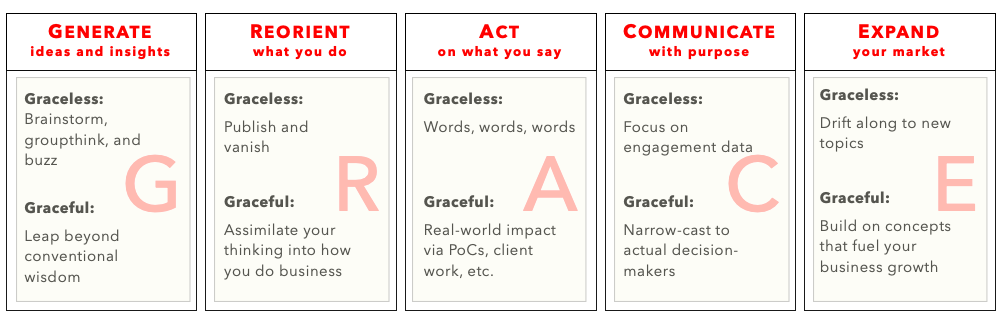 The GRACE Model
Generating Ideas That Matter
The process involves working through a set of grids in logical order. Doing so alternates between group-facilitated exercises and activities done individually or by a small team of idea-generation leaders doing exercises and background analysis.
The typical rhythm is individual work on a grid, followed by group consensus-building sessions, from which idea analysts extract concepts for the next round. Using this method culminates in discovery sessions with thought leaders designated to flesh out ideas and to be their public face. It takes between six and eight weeks when done efficiently.
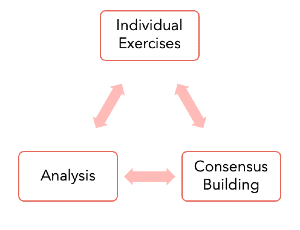
An Iterative Process
Ideally, strategy, marketing, and product development resources all play a part in the process and have dedicated representation in the working team. An external idea strategist can also help by identifying ideas, clarifying them, and pushing them past common knowledge or stale ideas.
A Note on AI as an Analytical Tool
AI supports the analytical work within the GRACE process. The grids require real inputs like industry trend data, competitive positioning, evidence of delivery. AI can compress the time and effort it takes to do this research without sacrificing rigor, provided it is used at the right points and with the right skepticism.
In the Strategy Stage, AI can help you scan and synthesize industry structure trends, regulatory developments, and competitor positioning at scale. It surfaces patterns across large bodies of material faster than any research team can manually.
In the Brand Thesis Stage, AI can accelerate competitive analysis by identifying how peers and adjacent players are positioning themselves, where messaging is crowded, and where genuine white space exists.
In the Idea Stage, AI can help surface evidence demonstrating delivery against a brand thesis: case studies, data points, and proof-of-concept examples. This is particularly valuable when the evidence exists within the organization, fragmented across scattered reports, client testimonials, and internal project outcomes.
However, never forget that AI is an accelerating convenience. It is not a replacement for human judgment. You still need your best marketing thinkers and subject matter experts in the room to evaluate all of these incoming signals.
There's another hidden limitation of AI that can lead to strategic mistakes as well. AI trained on publicly available material will tend to surface consensus views. The GRACE process is specifically designed to move past consensus toward differentiated ideas. Use AI to handle the volume of background research, and rely on the working team and thought leaders to push beyond what the models surface.
Strategy Stage
What are the core strategic intents of your company?
In the strategy stage, you create a grid of your main strategic pillars and the contexts where they matter. The columns include your main strategic pillars. The rows represent major industry structure trends, industry challenges, market trends, and tech/product trends customized to the specific details of your business. In the cells, you describe your company’s strategic intent in a brief statement.
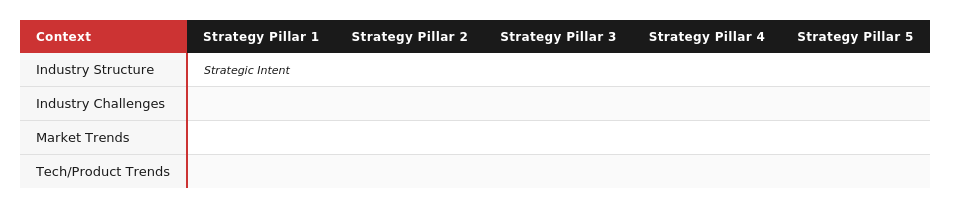
Strategy Grid
For example:
- The strategic intent for a strategy to capture market share in a rapidly consolidating industry might be to win away clients who feel concerned about service gaps in recently acquired firms.
- The strategic intent for a strategy to become a technology disruptor in your industry might be to tokenize a particular complex asset class.
From this grid, you extract a small number (7–10 max) of priority intents. Prioritization is the primary goal of consensus-building sessions.
Brand Thesis Stage
What is your core differentiated message for each strategic intent?
In the brand thesis stage, you align your prioritized strategic intents and top-line brand messages. The columns represent your main brand pillars. The rows come from the strategy stage.
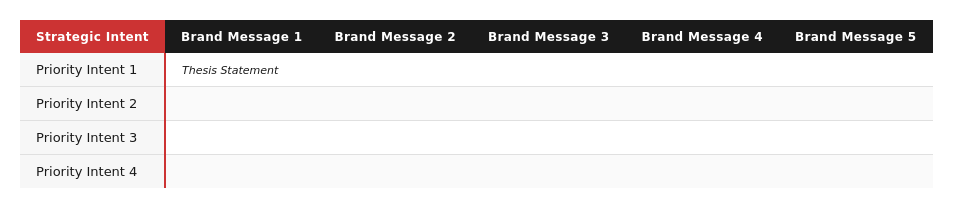
Brand Thesis Matrix
For example:
- You might have a brand message related to delivering consultative and expert service to clients. If you adopt an intent to win away customers from acquired competitors, your brand thesis could be something like, “Our Account Teams of experienced professionals in our client’s industries are structured to maintain service levels without disruption.”
- You might have a brand message related to your technology leadership. If you adopt an intent to tokenize an asset class, your brand thesis could be something like, “We provide a platform that provides reliable connection points between counterparties using the Cardano ecosystem.”
Admittedly, it’s hard to provide generic examples that don’t sound like sludge!
From this grid, you extract a small number (again, 7 – 10 max) of your company’s most credible, forceful, and differentiated brand theses. Doing so requires consensus building and a separate process of deep competitive analysis.
Idea Stage
What are the high-potential ideas that will drive growth, visibility, and internal engagement?
Here’s where we get down to the level of the idea. An idea is the intersection point between your prioritized strategic intents, differentiated brand theses, and demonstrated evidence of delivery. It’s not “Oooh, what if we…” And it only counts as an idea for ideas-led growth if it expands your company, increases your reputation, and strengthens employee commitment.
In the idea stage, you map out specific evidence that demonstrates you can and will deliver what your differentiated brand theses say. If your message speaks to uninterrupted service levels, what insights from your head of client services or COO help show that? What case studies prove that? Those are the elements that become the columns of this final grid.
A nuance emerges here, too. The evidence can reflect future plans, recognizing that they might have to come to fruition before they actually lead growth.
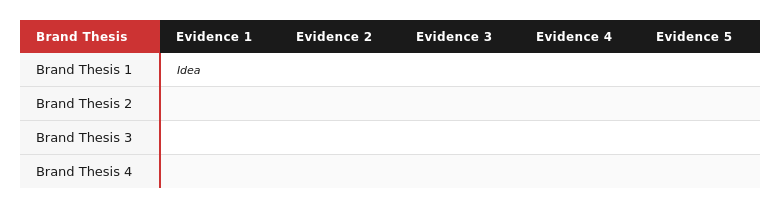
Idea Grid
For example, to carry through to the end:
- From the service-level brand thesis, your idea might be a proprietary approach to training and retaining talent. That idea becomes the anchor for growth (how you recruit, how you win clients), thought leadership (what you talk about in public), and employee messaging.
- From the Cardano ecosystem brand thesis, your idea might be a proof-of-concept demonstrating an efficient and secure multi-asset ledger approach appropriate for trading in regulated environments.
Summary of the Process
Ideas must have a specific meaning and emerge from a disciplined process to result in growth. However, working with this level of diligence and attention creates an engine for future opportunities anchored in specific ideas articulated by your strongest thought leaders and driving continued innovation. For marketers in our industries, the output of this process feeds directly into go-to-market execution: the thought leadership content you produce, the narratives you bring to conferences and awards programmes, and the sales enablement stories that turn pipeline into revenue.
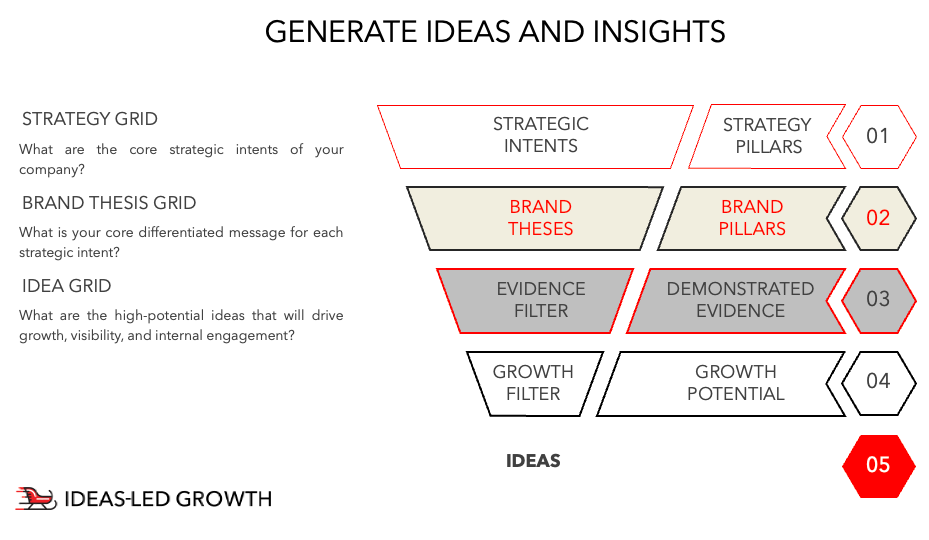
How to Generate Ideas
Written by: Christopher G. Fox, PhD, Founder and CEO, Ideas-Led Growth, helps financial institutions and fintech leaders express serious ideas with precision and authority. The company offers thought leadership strategy and writing for capital markets, asset management, banking, and financial infrastructure clients. They work with institutions navigating complex asset classes, regulatory regimes, and operating models. They translate institutional knowledge into clear, credible perspectives that earn trust and compound reputation over time.